This post does not contain a price per square. That is deliberate, and it is the most useful thing we can tell you about metal roofing pricing.
What it does contain is the structure of a standing seam material price: the six variables that move it, how much each one moves it relative to the others, and where contractors most often get surprised. If you understand the structure, you can look at a quote and know why it says what it says. Then you can get the actual number for your actual job in IMQ, in minutes, priced today rather than priced whenever a blog post was last edited.
Why we are not publishing a number
Coil pricing moves. It moves with the steel and aluminum markets, with mill lead times, with freight, and with what is actually in stock in a given gauge, substrate and color. A number we published in one quarter would be wrong in the next, and a contractor who bid off it would eat the difference.
The cost guides that do publish figures are mostly honest about this if you read them closely. One supplier's self-serve pricing page calls its own output a ballpark quote based on square footage, adds that its sample figures are rough estimates and are not to be taken as quotes, and points you to a detailed materials and cost analysis for anything real. Another standing seam supplier skips the calculator entirely and says it generally completes a quote within three days. Both are being straight with you. Neither hands you a number you can bid on this afternoon.
There is a bigger problem with published ranges. Nearly all of them are installed prices aimed at homeowners, blending material, labor, tear-off, disposal and the installer's margin into one figure. That is useless to a contractor. You are buying material, not an installed roof, and separating the two is the point of this post.
The six things that move a standing seam material price
Roughly in order of how much each one moves the number on a typical Florida residential job:
- Substrate - Galvalume steel or aluminum.
- Finish - mill finish, SMP, or PVDF.
- Gauge or thickness - 24 gauge, 26 gauge, or 0.032 inch aluminum.
- Panel geometry - coverage width and seam height.
- Trim and accessory quantity - driven by roof shape, not roof area.
- Waste factor - and this is the one exact-length fabrication changes.
Notice what is not on that list: square footage. Square footage scales the price, it does not drive it. Two roofs with identical square footage can land far apart, and the reasons are all above.
Substrate: Galvalume steel or aluminum
This is usually the largest single swing in the material number, and it is a Florida decision more than a budget decision.
Aluminum carries a higher material cost than Galvalume steel. It is also what we quote for oceanfront work, because aluminum does not corrode where a coating is scratched or where a cut edge is exposed. A few hundred feet from salt spray, that property is worth paying for. Twenty miles inland it usually is not, and Galvalume steel with a good coating is the right call. We worked the decision rule through by distance in aluminum versus steel by distance from salt air.
The catalog reflects this. Our M100 mechanical lock panel is 0.032 inch aluminum, PVDF finish only, and it holds HVHZ and Miami-Dade approval under FL41812.03-R1. M150 is offered in either 24 gauge steel or 0.032 inch aluminum, so on that profile the substrate is a live choice rather than a given. Verify the current approval revision at floridabuilding.org before submittal.
Finish: mill, SMP, or PVDF
Finish is the second lever, and the published warranty terms are the clearest way to see what you are buying. These are the terms from the coil producer's published warranty, and they are the only finish numbers we will state:
| Substrate and finish | Published material warranty |
|---|---|
| AZ55 acrylic-coated Galvalume steel, mill finish | 20 years |
| Galvalume steel or aluminum with Sherwin-Williams Kynar 500 (PVDF) | 35 years |
| Galvalume steel with Sherwin-Williams WeatherXL SMP | 40 years |
A mill finish panel is the least expensive way to put standing seam on a building and it is a legitimate choice on a barn, a shed or a utility structure. It is not the choice for a house someone will look at every day for thirty years.
Between SMP and PVDF, the cost delta is real and the performance question is genuinely different from the warranty question, which is why we treat it separately in PVDF versus SMP for Florida coastal roofs. One thing worth knowing at quote time: color availability is not uniform across finishes or substrates, and a color that has to be run rather than pulled from stock affects both price and lead time. Check color and coating options before you promise a customer a specific color on a specific deadline.
One more thing belongs here because it comes up in warranty conversations constantly. Oil canning is not a defect. It is a visual characteristic of flat metal in a flat plane, it is not grounds for a warranty claim, and no finish upgrade buys you out of it. Panel width and substrate influence how visible it is. Nothing eliminates it.
Panel geometry: coverage width and seam height
A panel's coverage width is how much roof one panel covers. Its flat width is how much coil it consumes. The gap between those two numbers is the seam, and it is where a lot of material cost quietly lives.
Two consequences follow, and they run in opposite directions:
- Narrower coverage means more panels per square. More panels means more linear feet of seam, more clips, more fasteners, and more crew hours to set them. Narrow-panel roofs look excellent and cost more in both material and labor.
- A taller seam consumes more coil for the same coverage. A 1.5 inch seam takes more flat width than a 1 inch seam, so on identical square footage the taller profile buys more metal. Whether that is worth it is a water-handling and wind question, not a cost question. Seam heights and coverage widths per profile are on the standing seam page.
Gauge sits alongside this. Thicker metal is more metal. 24 gauge costs more than 26 gauge on the same panel, and it dents less, oil cans less visibly, and spans better. Across our standing seam line 24 gauge is the standard, with NS100 the one profile offered in both 24 and 26 gauge - and those two carry separate approvals, separate coverage widths and separate load ratings. Neither NS100 gauge is HVHZ approved. The gauge post goes deeper.
Trim quantity, which is driven by shape and not by area
This is where estimates go wrong most often.
Panels scale with roof area. Trim scales with roof complexity. Ridge cap, hip cap, valley, drip edge, rake, endwall and sidewall flashing, plus closures, fasteners and sealants - all of that is a function of how many planes, hips, valleys, dormers, chimneys and wall terminations the roof has. A simple gable and a cut-up hip roof of identical square footage are not the same order, and the difference is not small.
Trim also has to match the panel: same gauge, same substrate, same finish, and ideally the same color run, because color varies slightly between runs and a rake that does not match reads as a mistake from the ground. Ordering trim later, separately, is how a job ends up with two shades of the same color. The trim and accessories ordering checklist covers what to specify, and our accessories page covers what we fabricate.
Waste factor, and why exact-length fabrication changes the math
Every metal roof estimate carries a waste allowance. What that allowance needs to be depends entirely on how the panels are produced.
Buy stock-length panels and you cut them down on site. Every run that does not divide evenly into the stock length produces an offcut, and offcuts on a coated panel are scrap, not inventory. Long runs that exceed the stock length need end laps, and an end lap consumes overlap material plus sealant plus an extra row of fasteners, at every lap, on every panel.
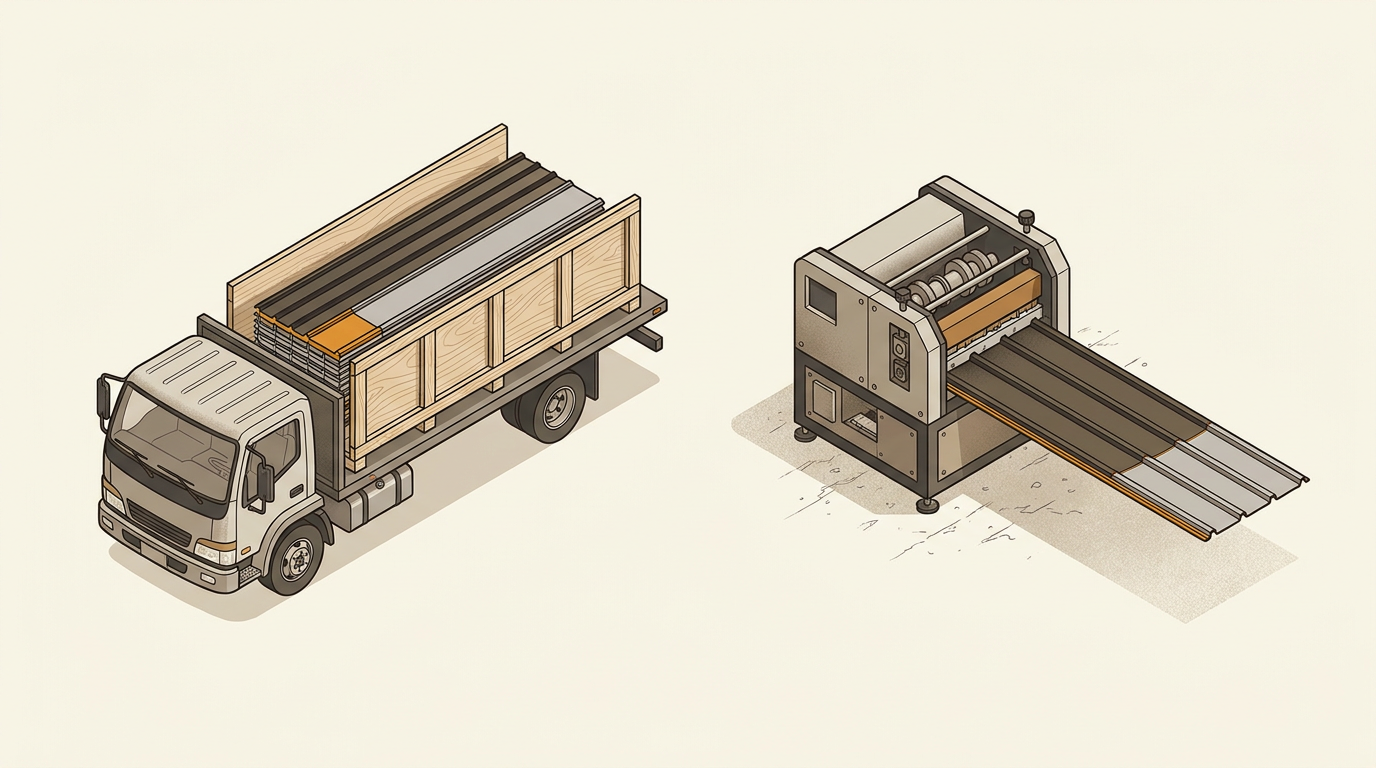
Our panels are fabricated to exact length by our Florida fabrication partners and delivered crated. Each panel is made to the length of the run it goes on. That does three things to the waste line:
- Cut-down scrap on panels largely disappears. There is no stock length to reconcile against, so the dominant source of panel waste is gone.
- End laps are eliminated on runs we can fabricate in one piece, which removes the lap material, the sealant and the extra fasteners along with the leak path.
- Transit damage replaces cutting scrap as the thing to manage, which is why panels ship in crates set by forklift rather than loose on a flatbed. Crated delivery exists for this reason.
Here is the honest tradeoff, because there is one. When a panel is cut to exact length, a measurement error is a reorder, not a trim cut. You are trading the flexibility of on-site cutting for the elimination of most waste and every end lap. That trade is worth taking on nearly every job, and it is why field measurement verification exists as an add-on. The remaining waste in a well-run exact-length job comes from measurement error, handling damage and trim fabrication offcuts. Not from panels.
If you want the full argument on production method, including the cases where onsite roll forming genuinely wins, we made it in crated panels versus onsite roll forming.
The Florida variable nobody prices in: eligibility
In Miami-Dade and Broward, cost optimization runs into the building code before it runs into the budget.
Those two counties are the High Velocity Hurricane Zone. Inside the HVHZ a panel either holds HVHZ and Miami-Dade approval or it is not an option at any price. SL100, SL150, NS150, M100 and M150 are HVHZ and Miami-Dade approved. NS100 is not. 5V crimp is not. So the standard move of value-engineering down to a less expensive profile is simply unavailable on a job in Miami or Fort Lauderdale, while the identical house in Orlando has options.
We would rather be blunt about that at quote time than lose a job at plan review. Confirm current approval revisions at floridabuilding.org before you submit.
What is not in the material number
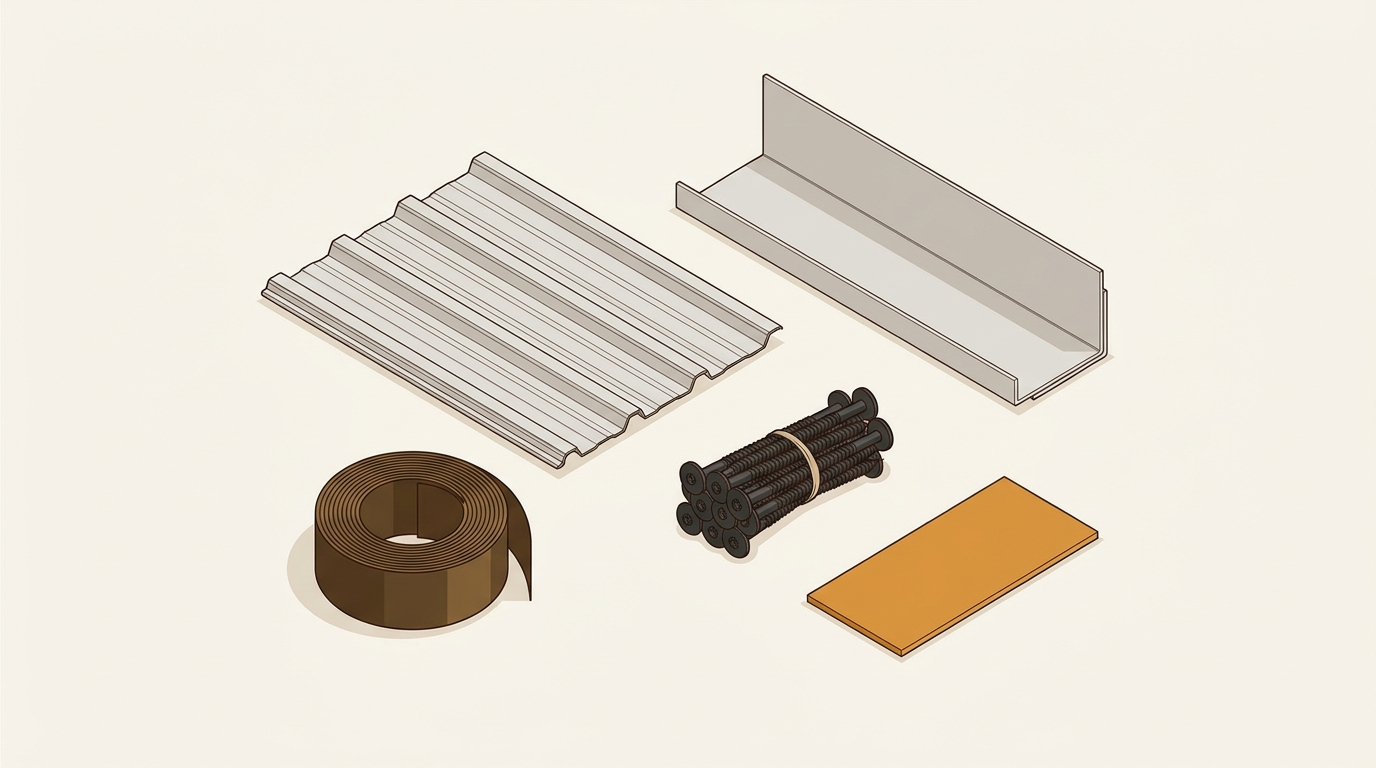
So the line is clear: a material quote from us covers panels, trim, flashings, fasteners, closures, sealants, underlayment where you include it, fabrication to exact length, crating and delivery.
It does not cover labor, tear-off, disposal, deck repair, permit fees, or your overhead and margin. If you want labor from us, turnkey installation through ERS Installations is a separate line you can add. Everything else is yours to build the bid around, and we think that is the correct division. We know what the metal costs. You know what your crew is worth.
Get the real number
Take a standing seam job you are working right now, put the panel, dimensions, substrate, finish and location into IMQ, and you will have an itemized material list in minutes rather than days. It is priced against current material, and it breaks out panels and trim separately so you can see which of the six levers above is actually moving your number. Background on how the platform fits into a bid is in our IMQ walkthrough, and the v2.0 release note covers county-level tax handling.
If you would rather have a person walk the first one with you, contact sales or book a call.