Onsite roll forming is genuinely better than factory-fabricated panels on a specific class of job, and most of the content you will find on this question is written by companies that sell the machines or the service. We are not one of them. ERS Metals fabricates panels to exact length through our Florida fabrication partners and delivers them crated, and onsite roll forming happens only when a job genuinely requires it. That is the position, stated up front, and the rest of this post explains where it is right and where it is not.
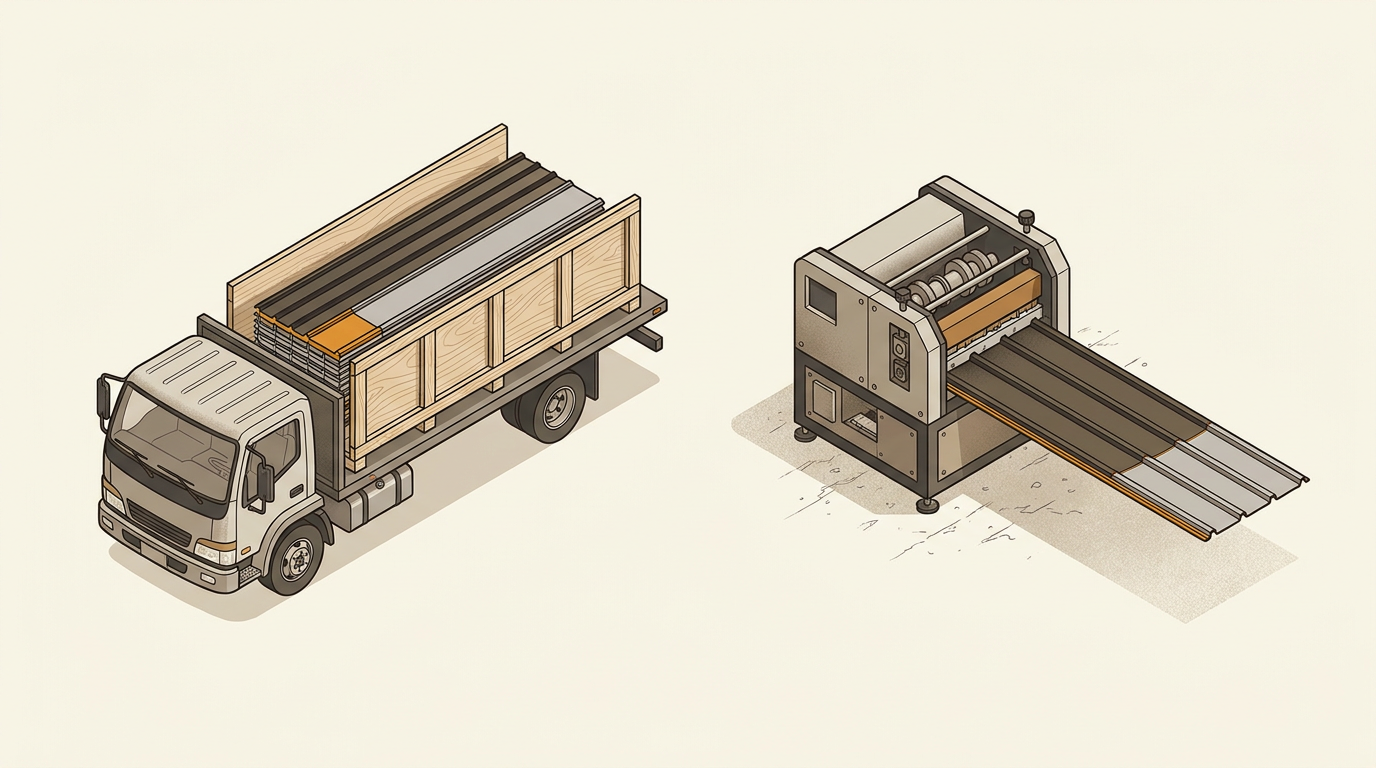
The short version: if you have continuous runs longer than a truck can legally carry, roll form onsite. If you do not, exact-length factory panels in a crate win on quality control, on crew time, on cost, and on the condition the panels are in when they reach the deck.
What onsite roll forming genuinely does better
These are real advantages and we are not going to argue with them.
Very long continuous runs with no end laps. This is the strongest argument on the pro side and it is not close. A formed panel has to travel by road, and Western States Metal Roofing puts the practical shipping ceiling at roughly 55 feet. Beyond that, a factory panel does not exist as a single piece, and the alternative is an end lap. McElroy Metal, which offers onsite roll forming as a service, describes single-piece panels running up to 250 feet and describes end laps as prone to leaking from the expansion and contraction of roof panels. Both statements are accurate. On a 120 foot commercial slope, onsite roll forming is not a marketing preference. It is the answer.
No crating cost. Crates are hardwood, they are built per order, and they are a real line item. A roll formed panel goes from the machine to the roof without ever being packaged. On a large job that adds up.
No shipping damage exposure on formed panels. A panel that never rides a truck cannot be damaged on a truck. A coil survives a truck ride that would crease a formed panel. McElroy also points out the freight efficiency: a truck can carry roughly 40,000 pounds of coil against 20,000 to 25,000 pounds of formed panels, because formed panels ship mostly air. Fewer trucks, less fuel, less handling.
Late changes. If the roof turns out different from the takeoff, the machine is already there. A factory reorder is a new order.
What onsite roll forming costs you, in the same honest terms
The same sources that sell the service are clear about the constraints, which is to their credit.
- Weather. Western States states plainly that roll forming should not be done in rain or heavy winds. In Florida that is not a footnote. From June through September, an afternoon convective storm is a near-daily event across most of the peninsula, and hurricane season runs June 1 to November 30. A process that stops when the sky opens is a process that stops a lot here.
- Manpower to move the panel. McElroy's guidance is roughly one laborer per 15 feet of panel. A 90 foot panel is a six-person carry before anybody has fastened anything. That labor is on your payroll.
- Height and access limits. McElroy cites eave height restrictions around 30 feet and requirements for hoisting equipment, turning radius and overhead clearance. Western States notes the site has to have room for the machine plus forklifts, cranes or ramps.
- Equipment and operator. The machine has to be mobilized, set up, calibrated and run by someone who knows it. That is a person not installing roof.
- Quality control moves to the jobsite. A shop runs the same profile all day with the same setup and the same checks. A machine set up in a driveway is being verified by whoever set it up that morning.
None of that makes onsite roll forming bad. It makes it a process with a mobilization cost and a set of site preconditions, which is exactly what it is.
What exact-length factory fabrication does better
Consistent quality control. A fabrication shop forms panels in a controlled environment with a fixed, maintained setup and repeatable checks. Profile dimensions, seam geometry and cut length are verified against the same standard on every order rather than against whatever the site allowed that day. On a panel whose Florida product approval covers a specific assembly, consistency in the formed profile is not a nicety.
No machine mobilization and no crew time running it. Nobody on your crew spends the day operating a roll former. There is no machine to schedule, position, protect overnight or demobilize. Your labor is spent setting panels.
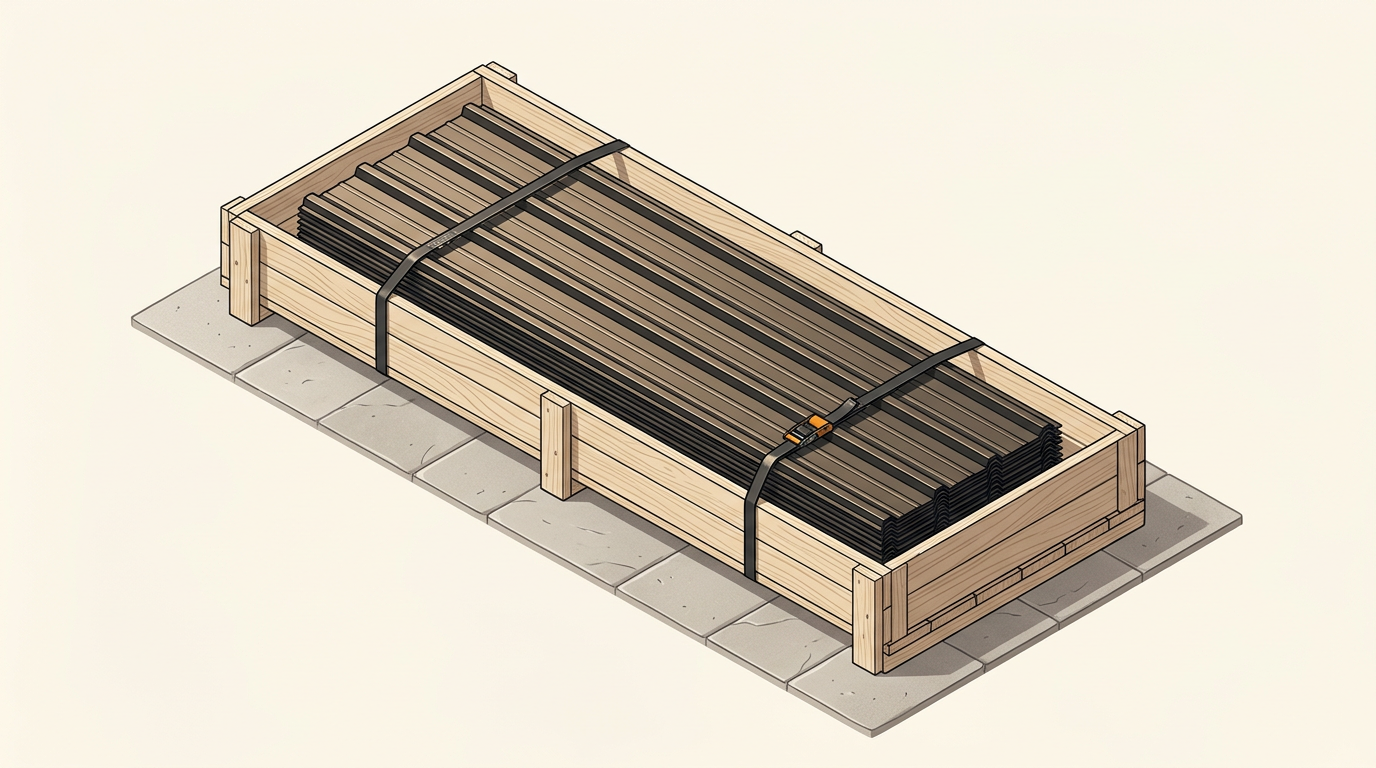
Panels that arrive protected. Hardwood crates set by forklift keep the bundle off the ground and supported along its length, and let the crew pull panels one or two at a time as they are needed. The finish damage that shows up on a completed metal roof is usually a handling and staging problem, not a transit problem, and a crate is the control for it. Sheffield Metals' handling guidance is explicit about never setting panels directly on the ground and about separating and drying bundles that get wet, which in a Florida summer is a chore worth designing out.
Accuracy on small and mid-size jobs. This is where the comparison actually gets decided, because this is what most Florida roofs are. A residential hip roof is a schedule of thirty different lengths, several of them trapezoidal, none of them 55 feet. A shop cutting from a verified measurement produces that schedule cleanly. A machine in the driveway producing thirty different short lengths is doing the same work with more setup and more chances to mismeasure at the point of cut.
Predictable scheduling. The crate arrives on a date quoted on your order confirmation. There is no weather window to hit on the front end.
The comparison, side by side
| Factor | Onsite roll forming | Exact-length factory panels, crated |
|---|---|---|
| Maximum continuous run | Effectively unlimited; single-piece panels of 250 feet are documented | Limited by road transport, roughly 55 feet as an industry practical ceiling |
| End laps | None, at any length | None on typical Florida runs; required only beyond transport length |
| Crating cost | None | Real, and included in the order |
| Transit damage risk to formed panels | None; coil ships instead | Present, and managed with hardwood crating and delivery inspection |
| Quality control | Depends on the setup and operator that day | Fixed shop setup, repeatable checks across orders |
| Weather dependency | High; no forming in rain or heavy wind | None on the forming side |
| Crew time not spent installing | Machine operation plus roughly one laborer per 15 feet of panel to move it | Unloading from the crate |
| Site requirements | Machine footprint, hoisting, turning radius, eave height typically under about 30 feet | Forklift access to set a crate |
| Best fit | Long continuous commercial runs; sites a crated bundle cannot reach | Residential and light commercial; complex multi-plane roofs; anything under transport length |
Where the line falls on a Florida job
Pick roll forming when the run length forces it. That is the honest trigger, and it is mostly a commercial trigger: long uninterrupted slopes on warehouses, agricultural buildings, arenas and big-box retail. A secondary trigger is access, where a site genuinely cannot receive a crated bundle of long panels, which happens on tight urban lots and some island work.
Pick exact-length factory panels for everything else, which in Florida is most things. The residential stock through Jacksonville, Orlando, Tampa and South Florida is hip-heavy and multi-plane, with runs well inside transport length. Those roofs need a lot of different accurate lengths, not one very long one. That is a shop problem, not a machine-in-the-driveway problem.
One more Florida-specific note on the compliance side. Your Florida product approval covers an assembly, and what gets installed has to match what was submitted, including panel profile, gauge, substrate and attachment. That is true whichever way the panel is formed. It is simply easier to demonstrate consistency when the forming happened in a shop with a documented setup, and it matters most in Miami-Dade and Broward where inspection scrutiny is highest.
What ERS does, and why
We fabricate to exact length and deliver crated. That is the standard on every order: panels cut for each run, packed in hardwood crates, delivered on our own trucks in Northeast Florida and as crated statewide freight everywhere else in Florida with a delivery date quoted on the order. The mechanics are on crated delivery, and we go through the handling side in detail in how crated delivery and exact-length panels protect a job.
Onsite roll forming happens when a job genuinely requires it. We are not against it and we are not going to pretend the physics favor us on a 120 foot run. What we will not do is lead with it, because leading with it oversells the exception. On the jobs where it is not necessary, mobilizing a machine is cost and weather risk you are carrying for no return.
The corollary is that our process puts more weight on the measurement, and we would rather say that than hide it. A cut-to-length panel is cut to your number. That is why field measurement verification exists as a service and why we recommend it on complicated roofs. We wrote up the specifics in field measurement before you order exact-length panels.
Questions worth asking whoever is quoting you
- What is the longest continuous run on this roof, and does it exceed transport length? If not, the roll forming argument mostly evaporates.
- If roll forming onsite, who operates the machine, and what happens to the schedule when it rains for three days?
- How many people does it take to move the longest panel, and is that labor in the quote?
- If factory formed, how are the panels packaged, and who inspects the load on delivery?
- Whichever way the panels are formed, does the installed assembly match the Florida product approval that was submitted?
- Who owns the measurement, and what happens if it is wrong?
A supplier who cannot answer number five and number six specifically is a supplier worth pressing harder.
Next step
If your job is standard Florida geometry, build it in Instant Metal Quote and you will get a material list with exact panel lengths on it. If you have a long-run commercial slope and want a straight answer about whether onsite forming is the right call, contact sales and describe the roof. We would rather tell you the exception applies than sell you the standard.