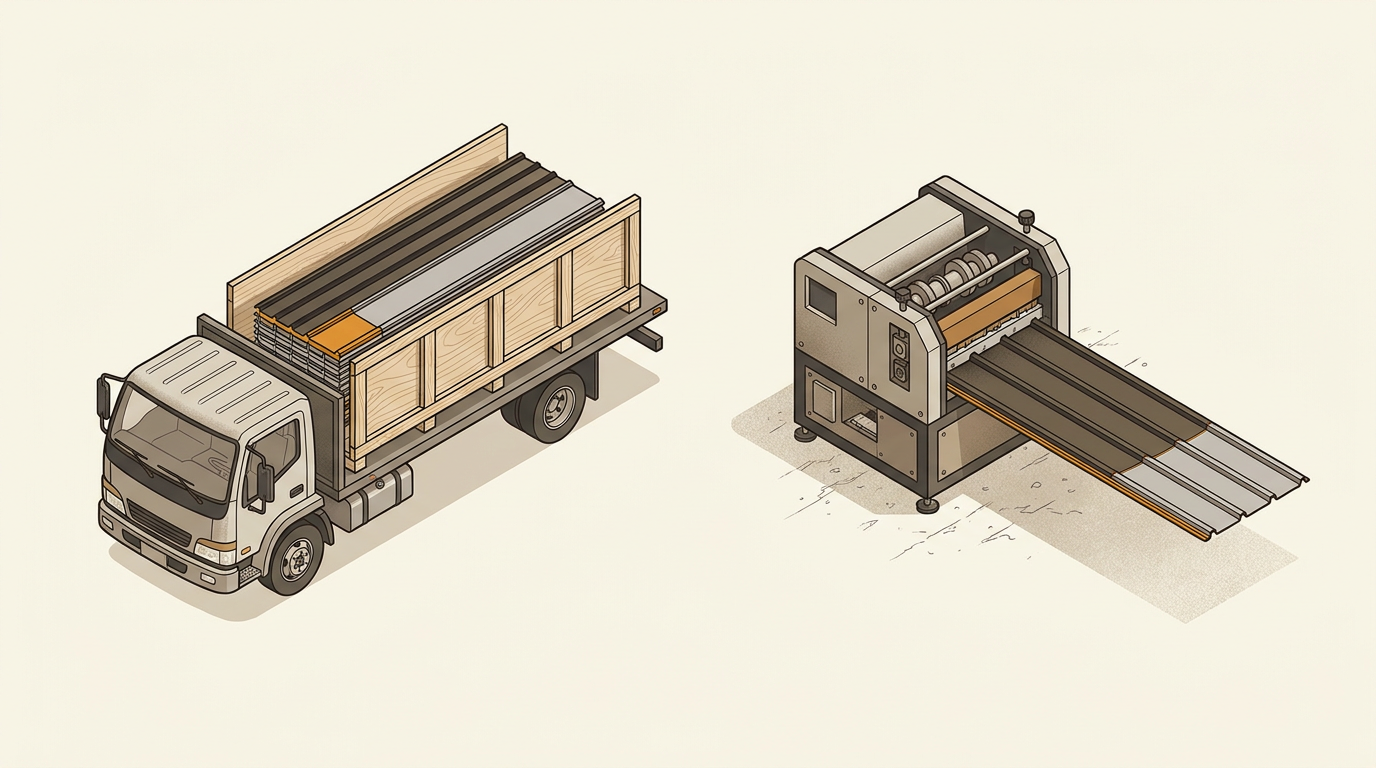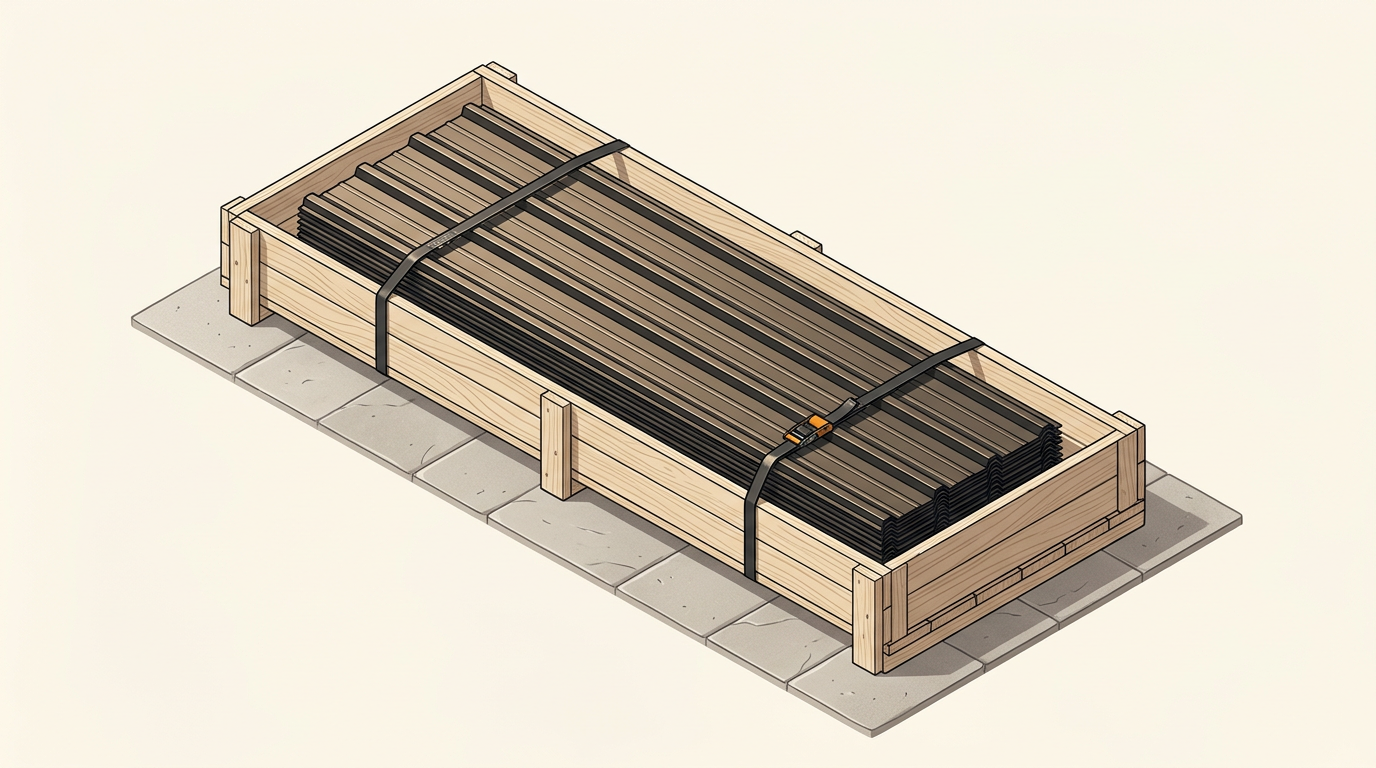
Every panel on an ERS Metals order is cut to the length of the run it covers before it leaves the shop, and it arrives on the job inside a hardwood crate. Those two facts protect a metal roofing job more than anything else we supply. Exact length removes end laps. The crate removes the scratched finishes, the bent ribs and the stepped-on panels that turn a clean install into a punch list.
This is the standard on every order we take. Panels are fabricated to exact length by our Florida fabrication partners, then delivered crated. It is not a premium upgrade and it is not something you have to ask for. It is how the order ships, from Miami to Jacksonville.
What fabricated to exact length actually means on your order
A coil of 24 gauge Galvalume arrives at the fabrication shop as a roll. It leaves as panels cut for one specific roof: this run at 18 feet 4 inches, that run at 22 feet 11 inches, the dormer runs at 7 feet 2 inches. Nobody on your crew cuts a panel to length on the deck. The numbers come from your takeoff, from an Instant Metal Quote material list, or from a verified onsite measurement, and the shop cuts to them.
There is a consequence worth stating before any of the benefits. Cut to length means cut to your length, right or wrong. A panel that is three inches short at the ridge is a field fix, and a panel that is three inches long at the eave hangs wrong over the gutter. Metal America puts it bluntly in its ordering guidance: custom-cut panels are manufactured to your specified dimensions and cannot be returned or exchanged. That is true of any exact-length program, ours included, and it is exactly why we push contractors toward field measurement verification on anything with complicated geometry. We wrote a full piece on what to check before you order exact-length panels.
End laps are the thing exact length removes
An end lap is a horizontal joint where two panels meet part way up a slope. It is the joint nobody wants on a standing seam roof. McElroy Metal, which sells onsite roll forming as a service, describes end laps as prone to leaking from the expansion and contraction of roof panels, and describes the lap detail itself as time consuming for installation crews. Both of those are true, and we agree with them.
Florida makes the expansion and contraction argument worse rather than better. A dark panel on a Jacksonville roof in July and the same panel at four in the morning in January are not the same length. The roof moves every single day. A concealed-fastener standing seam system is designed to let it move, and an end lap is the one place in the assembly where that movement is being asked to happen across a sealed horizontal joint. Then add the afternoon convective storms that run from June into September and put water on that joint several times a week.
Exact-length fabrication removes the joint instead of detailing it. On the overwhelming majority of Florida residential and light commercial slopes, one panel covers eave to ridge with nothing in between. That is fewer sealant beads, fewer fasteners in the flat of the panel, and fewer things to inspect in five years.
- No horizontal joint on a typical eave-to-ridge run
- No lap sealant to install correctly at height, in heat
- Less field cutting, so fewer hot filings left on a finished panel
- Waste that lands in the shop scrap bin rather than in your dumpster line item
The honest limit: the ceiling on a factory-formed panel is a trucking constraint, not a forming constraint. Western States Metal Roofing puts the practical shipping ceiling at roughly 55 feet, past which a formed panel is not going down a road on a truck. Runs longer than that exist in Florida, mostly on large commercial slopes, and they are the one case where the answer changes. We treat that honestly in crated panels versus onsite roll forming.
Why the crate matters more in Florida than in most places
Panels are fragile in a specific and annoying way. The steel is fine. The finish is not. A 24 gauge panel that gets dragged across a bundle, walked on, or left flat in wet grass for a week is structurally perfect and cosmetically finished, and a homeowner will see the difference from the driveway.
Our panels ship in hardwood crates that are set on the driveway or the staging area by forklift. The crate does four jobs at once:
- It keeps the bundle off the ground. Sheffield Metals' handling guidance is explicit that panels should never sit directly on the ground and should be supported along their full length. A crate does that by construction rather than by somebody remembering to lay out two-by-fours.
- It gives the panels one rigid handling unit. Panels come out of the crate one or two at a time, on edge, as the crew needs them, rather than the whole bundle being shuffled around the yard.
- It stops incidental jobsite damage. The scratches that show up on a finished roof are almost never from the truck. They are from ladders, from other trades, from a bundle being walked across.
- It handles Florida weather during staging. Bundles that sit in the rain trap water between sheets. Sheffield's guidance is that wet sheets should be separated, wiped and air dried without delay, which is a real chore on a stack of thirty panels. Crated panels stay stacked the way they were packed and are far easier to keep dry and shaded.
One Florida detail we tell every contractor: pull the protective film before the panels bake. Prolonged UV and heat make the film hard to remove and can leave adhesive behind. In a Florida summer that clock runs faster than the national guidance assumes.
How delivery actually works, stated honestly
In Northeast Florida we deliver on our own trucks. Jacksonville, Ponte Vedra Beach, Orange Park, St. Augustine, Fernandina Beach, Palm Coast and the surrounding counties are the radius where we control the truck, the driver and the offload.
Everywhere else in the state, from Pensacola to Tampa to Fort Lauderdale to Key West, orders move as crated freight with a delivery date quoted on the order. That date is a commitment we make in writing when we confirm the order, and it is the number to build your schedule around. We are not going to tell you a panel order lands the next morning, because on a statewide freight lane that is not a promise anyone can keep. Full coverage is on the service area page and the mechanics are on crated delivery.
What to do the moment the crate is set down
This is the ten minutes that decide whether a freight claim is easy or impossible.
- Walk the crate before the driver leaves. Look at the corners, the banding and the ends of the bundle.
- Photograph anything that looks wrong before you move a single panel. Photos of an undisturbed crate are worth far more than photos taken after unloading.
- Note the damage on the delivery receipt. A signed clean receipt makes a later claim very hard.
- Count the trim and accessories against the packing list, not against memory. Ridge cap, drip edge, rake, closures and fasteners are the items that stop a crew, and they are the easiest to miss on a walk-around.
- Stage the crate where the panels come out toward the ladder, not where the forklift found the flattest ground.
Where the waste math changes
Stock-length panels get bought long and cut short. Every run that needs 17 feet 6 inches out of a 20 foot panel writes off two and a half feet, and that write-off happens on your job, on your dumpster, on your labor. Exact-length fabrication moves the offcut back into the fabrication process, where the coil is being managed across many orders instead of one roof.
The install-time argument is the bigger one. Panels come out of the crate in run order. There is no measuring on the deck, no chop saw stand in the driveway, no shear cuts, and no crew member spending the morning cutting instead of setting panels. On a standing seam job, the labor that field cutting eats is not trivial, and it is labor being spent at height in Florida heat.
What about onsite roll forming
We do it when a job genuinely requires it, and not otherwise. The exception is real and it is narrow: continuous runs longer than a truck can legally carry, and a handful of access situations where a crated bundle cannot physically reach the staging area. Those jobs exist and we will quote them that way.
What we will not do is lead with it. Onsite roll forming means mobilizing a machine, a crew to run it and hoisting equipment to a Florida jobsite where an afternoon thunderstorm is a daily event for a third of the year. On the jobs where it is not necessary, that is cost and risk you are paying for and not getting anything back. For most Florida roofs, exact-length panels in a crate are simply the better answer, and that is what the standard order is.
Next step
If you want a material list with exact panel lengths on it, build the job in Instant Metal Quote and it will price the panels, trim and accessories together. If the roof has enough geometry that you would rather have someone verify it onsite first, that is what field measurement verification is for. If you would rather talk it through with a person, contact sales.