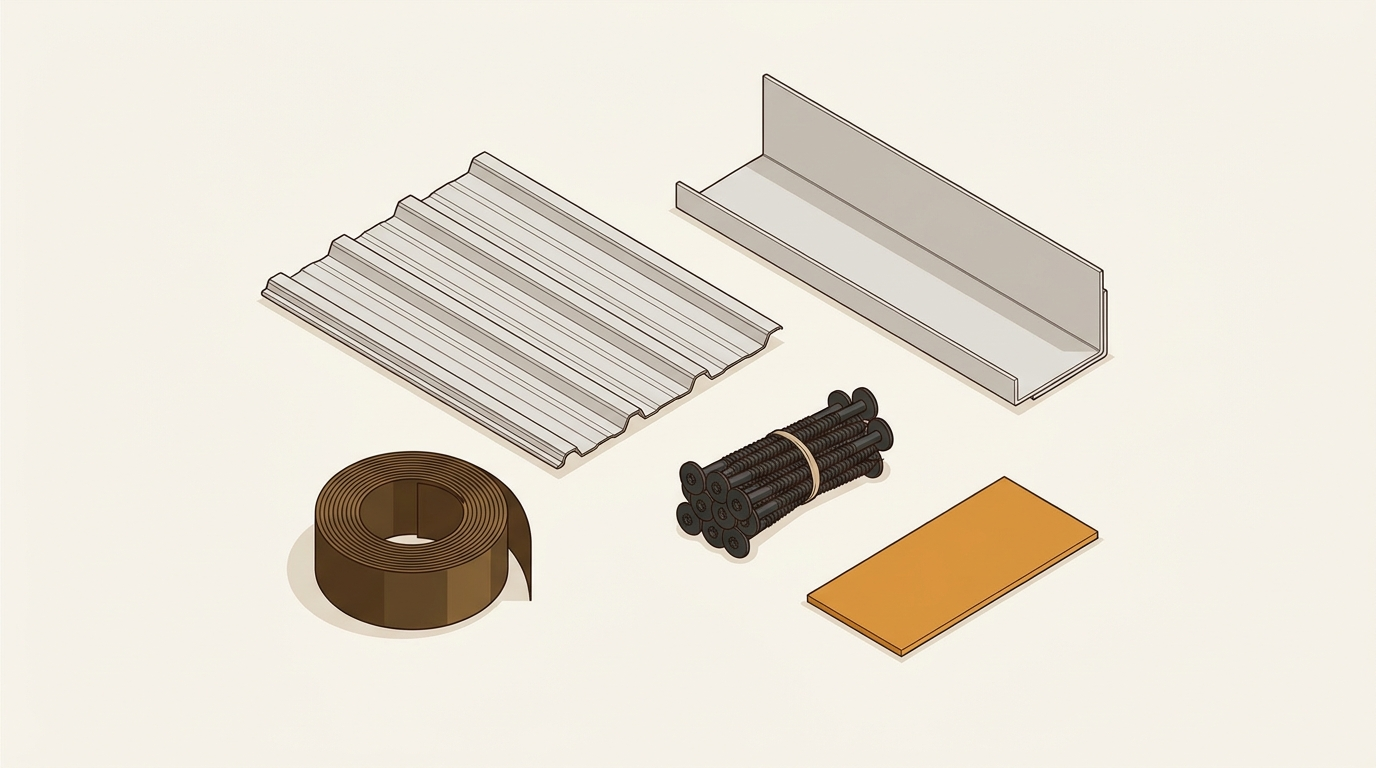
Specifying metal roofing at the design stage of a Florida new-construction project is a different job than a re-roof contractor swapping a panel on a bid. A re-roof contractor picks a panel for one building. A builder or general contractor is locking in a panel, gauge, finish, and color for a community, a submittal package that has to clear plan review before a permit is pulled, and a delivery sequence that has to match a build schedule across multiple lots or phases. Get the spec right at design stage and repeat ordering through the rest of the project is fast. Get it wrong and every phase after the first one is a substitution fight.
Specifying is not the same job as substituting
A spec written at design stage sets the panel, gauge, substrate, and finish before a single foundation is poured, and it travels with the plan set through every phase of the community. A substitution happens later, when a contractor or supplier proposes swapping what was drawn for something else, and it has to be re-approved against the same code requirements the original spec cleared. New construction favors specifying for a simple reason: a panel and finish decided once, with the Florida product approval already confirmed for the exact gauge and profile, does not need to be re-litigated at every phase or every plan reviewer.
Standardizing a panel and finish across a community
Multi-phase residential and light commercial work benefits from picking one standing seam profile and one finish for the whole project rather than letting it vary lot to lot. Standardizing on a single gauge and substrate keeps every phase under the same design pressure rating and the same approval documentation, and standardizing on one coating and color run keeps the finished product consistent across a subdivision instead of visibly different roofs going up six months apart. The tradeoff worth stating plainly: locking a spec early means committing before every lot's exact conditions are known, so build enough flexibility into the spec language to allow the same panel in more than one color if the community plan calls for variation.
Color consistency across phases is a scheduling question, not just an aesthetic one. Coil coatings run in production batches, so a color ordered for phase one and reordered a year later for phase four is not guaranteed to be an exact visual match to material already installed and weathered on earlier buildings. Where a builder wants a uniform look across the whole community, ordering enough material up front to cover multiple phases from the same run, or accepting minor variation between phases, is a decision worth making explicitly rather than assuming it will work itself out.
What actually goes in the submittal package
Plan review wants the Florida product approval number for the exact panel and gauge specified, plus the manufacturer's installation instructions that approval covers. Not a generic cut sheet for the product line. For a project that spans a Miami-Dade or Broward jurisdiction, that means the Miami-Dade NOA where it applies, not just the statewide FL number. Confirm the current revision of any approval number at floridabuilding.org before it goes into a submittal set, since revisions do get issued and an outdated revision number is a real reason for a plan reviewer to kick a package back.
HVHZ status can change what you're allowed to specify, not just how you install it
A builder standardizing a single spec across counties needs to know that HVHZ approval status is not uniform across our catalog, and in one case it is not even uniform within a single panel. SL100 (FL41812.05-R1), SL150 (FL41812.02-R1), NS150 (FL41812.01-R1), M100 (FL41812.03-R1) and M150 (FL46540.02-R0 in 24 ga steel, FL46540.03-R0 in 0.032 inch aluminum) all carry HVHZ and Miami-Dade approval. NS100 does not, in either 24 or 26 gauge. It is approved for use outside the High Velocity Hurricane Zone only.
PBR splits by gauge. The 24 gauge panel carries HVHZ approval under FL36968.2; the 26 gauge does not. Treating those two as interchangeable in a spec that spans both HVHZ and non-HVHZ phases of the same community is exactly the kind of error that sails through Jacksonville and then gets caught, expensively, at a Miami-Dade plan review. Write the gauge into the spec, not just the profile name. A spec sheet that reads correctly to a builder unfamiliar with the split can still fail review if the gauge line was left out or assumed, so this is a case where an early conversation with a supplier who works these approvals daily is worth more than the fastest quote.
Phased crated delivery scheduled to your build sequence
Panels are fabricated to exact length by our Florida fabrication partners and delivered crated - onsite roll forming is reserved for jobs that genuinely require it, not the standard approach. For a single building that means no end-laps and less jobsite waste. For a phased community, it means delivery can be scheduled in sequence against dry-in dates lot by lot, rather than one delivery for the whole project sitting in staging for months. Crated delivery protects panels in transit and on site, which matters more, not less, when material has to sit staged for a phase that is not dry-in ready yet.
Repeat ordering through IMQ once the spec is locked
Once a panel, gauge, and finish are locked at design stage, ordering the next phase is a repeat transaction, not a new quoting exercise. Instant Metal Quote lets a builder or their roofing contractor re-quote the same specification against a new set of dimensions for each phase, rather than starting the takeoff and pricing conversation over from scratch every time a new set of lots breaks ground. In practice that means the second, third, and later phases of a community can be quoted by whoever is running the job locally, whether that is the builder's own staff or the roofing contractor of record, without looping back through the same design-stage conversation about panel, gauge, and finish every time. The spec decision happens once; the ordering happens repeatedly.
What to hand us for an accurate first quote
The faster a builder gets an accurate first quote, the sooner the spec decision gets locked and the whole process above starts paying off. A quote request moves fastest with the following in hand:
- Roof plans for the model or models involved, with slopes, dimensions, and any complex geometry called out.
- A panel and finish selection if one is already made, or the performance requirements (design pressure, coastal exposure, color) if the decision is still open.
- The county and jurisdiction for each phase, so HVHZ status can be confirmed against the exact panel and gauge being considered.
- The build schedule or phase sequence, including target dry-in dates, so delivery can be planned against the schedule rather than guessed at.
- Site access details for delivery - road access for crated freight, staging space per phase, and anything unusual about the lots involved.
Field measurement still matters, even with a locked spec
A locked community spec sets the panel and finish, not the exact dimensions of every roof plane on every lot. Because panels are fabricated to exact length before they ship, a measurement error on any individual building still becomes a reorder rather than a field trim. Field measurement verification before ordering each phase keeps that risk out of the schedule.
Getting the spec in front of us early
The earlier a builder brings a panel and finish decision to ERS, the more of this we can help plan for: the submittal documentation, the HVHZ status across every county the community touches, and a delivery schedule that matches the build sequence instead of fighting it. That holds even at the earliest planning stage, before a full plan set exists. A rough sense of scope, county and target start date is enough for us to flag a gauge that will not carry HVHZ approval, or a color that runs into a lead time issue, before either gets baked into a spec book. Quote the first phase to see current specs and pricing, or reach out through contact to talk through a multi-phase spec before it goes into the plan set. For the delivery model behind all of this, see our guide to crated delivery.