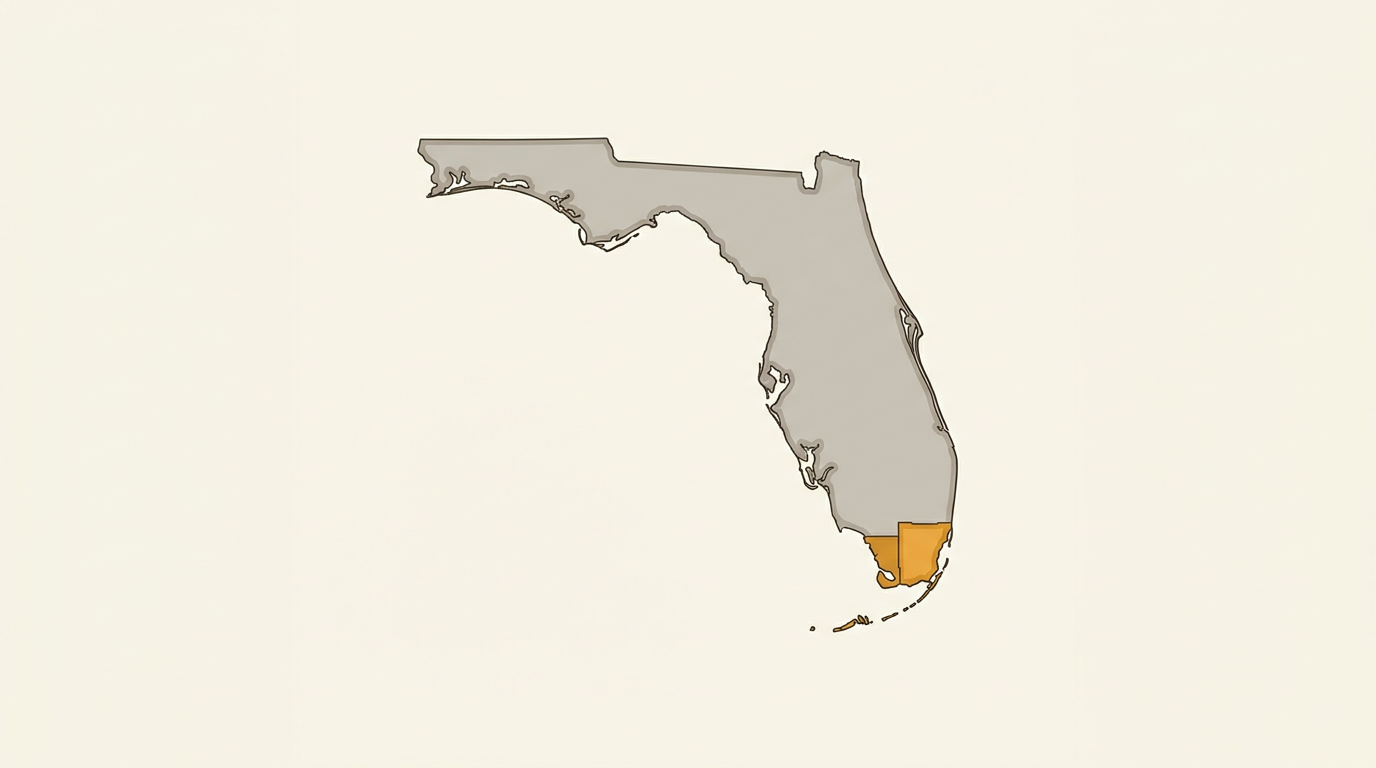
The High Velocity Hurricane Zone is Miami-Dade County and Broward County, both in their entirety. That is the whole definition, straight out of Section 202 of the Florida Building Code. There is no coastal strip, no mile line, no partial county. A job in Weston is in the HVHZ. A job in Homestead is in the HVHZ. A point worth being precise about is that Palm Beach County is not in the HVHZ, and neither is Monroe, which carries the highest design wind speeds in the state.
What changes when you cross that county line is not a matter of degree. Panels approved only for use outside the HVHZ are not permittable inside it at any price, with any upgrade, on any argument. Here is everything that actually changes on an order.
Which ERS panels you can specify inside the HVHZ
Start here, because this eliminates options before anything else does. The HVHZ column below is the compliance statement on the signed Florida Product Approval for that exact panel, not a sales position.
| Panel | Florida approval | Inside Miami-Dade and Broward |
|---|---|---|
| SL100, 1 in. snaplock, 24 ga steel | FL41812.05-R1 | Yes |
| SL150, 1.5 in. snaplock, 24 ga steel | FL41812.02-R1 | Yes |
| NS150, 1.5 in. nailstrip, 24 ga steel | FL41812.01-R1 | Yes |
| M100, 1 in. mechanical lock, 0.032 in. aluminum, PVDF only | FL41812.03-R1 | Yes |
| M150, 1.5 in. mechanical lock, 24 ga steel or 0.032 in. aluminum | FL46540.02-R0 steel, FL46540.03-R0 aluminum | Yes |
| PBR, 24 ga steel | FL36968.2 | Yes |
| PBR, 26 ga steel | FL36968.1, FL24397.6, FL27567.1 | No |
| NS100, 1 in. nailstrip, 24 ga or 26 ga steel | FL41812.04-R1 for 24 ga, FL46540.01-R0 for 26 ga | No |
| 5V crimp, 0.032 in. aluminum or 26 ga steel | FL24397.1, FL24397.2, FL24397.3 | No |
| Rib panel, 29 ga steel or 0.032 in. aluminum | FL24397.7 through FL24397.12 | No |
| Titanium PSU30 underlayment | FL11602-R19 | Non-HVHZ |
Read the bottom half of that table as a hard stop, not a caution. NS100 in either gauge, 5V crimp, rib panel and 26 ga PBR are outside-HVHZ products. We will not quote them into Miami-Dade or Broward, and a plans examiner who does their job will not pass them. There is no fastener pattern, sealant bead or engineering letter that converts a non-HVHZ approval into an HVHZ one. The approval either carries the flag or it does not.
The underlayment deserves its own sentence, because it is the piece most often forgotten. Titanium PSU30 carries FL11602-R19 and is a non-HVHZ approval. Section D of the HVHZ permit application asks for underlayment type by name, so whatever goes under the panel gets named on the paperwork and has to carry approval documentation the reviewer accepts for that assembly. Confirm the acceptable underlayment against the specific panel's approval documentation, and with the building department, before you order for an HVHZ job rather than at inspection.
The PBR gauge split, which is the one that catches people
Same panel name, same 36 in. coverage, same 1-1/8 in. minimum rib, and two different answers. The 24 ga PBR is HVHZ approved under FL36968.2. The 26 ga is not, in any of its three approvals. A submittal that says "PBR panel, FL36968" without the gauge and the decimal suffix is ambiguous on the one point that decides the permit.
The slope requirement splits with it. Inside the HVHZ the 24 ga PBR carries a 2:12 minimum slope. Outside the HVHZ, 1/2:12. That difference alone has killed low-slope commercial jobs that were priced on the outside-HVHZ number.
What changes in the testing behind the panel
Outside the HVHZ, FBC 1504.3.2 lets a metal panel roof system, through fastened or standing seam, be tested to UL 580, ASTM E1592 or TAS 125. Inside the HVHZ the path narrows to the Florida test protocols, published as their own code volume. Metal roofing sits at FBC 1523.6.5.2.4, which invokes:
- TAS 125-03, standard requirements for metal roofing systems
- TAS 100-23, wind and wind driven rain resistance of discontinuous roof systems
- TAS 110-2000, physical properties of roof membranes, insulation, coatings and components
One correction that will save you an embarrassing submittal. TAS 201, TAS 202 and TAS 203 are not roofing protocols. Large missile impact, uniform static air pressure and cyclic wind pressure are tests for envelope openings and cladding: windows, doors, shutters. If a package crossing your desk attaches TAS 201 to a roof panel, somebody copied it out of a window submittal. Do not forward it.
What does not change across the county line is the safety margin. FBC 1523.4 applies a 2:1 margin of safety to wind uplift resistance test results inside the HVHZ, and FBC 1504.9 applies the same 2:1 margin outside it. That is why the design pressures published on our standing seam approvals are allowable loads with a factor of safety of 2.0 already applied. They are not ultimate values and they are not the maximum design pressures quoted for 5V. Never restate one as the other.
What paperwork travels with the order
Inside the HVHZ the submittal is defined rather than local custom. FBC Section 1525 sets out a Uniform Permit Application, and for a metal roof you complete sections A, B and D with attachments 1 through 7. It helps to know which of those seven come off the product documentation and which are yours to produce.
Comes off the approval package, which is what ships with the order:
- Attachment 1, fire directory listing page
- Attachment 2, the product approval front page, specific system description, specific system limitations, general limitations and applicable detail drawings
- Attachment 4, other component of the product approval
Yours to produce for the specific job:
- Attachment 3, design calculations per Chapter 16, or RAS 127 or RAS 128 where applicable
- Attachment 5, municipal permit application
- Attachment 6, owners notification for roofing considerations, reroofing only, which is FBC Section 1524
- Attachment 7, any required roof testing or calculation documentation
Section D is the steep sloped roof system page and it is where the two halves have to agree. It asks for the roof system manufacturer, the notice of acceptance number, minimum design wind pressures for Zone 1, Zone 2 and Zone 3, deck type, underlayment type, fastener type and spacing, roof covering, drip edge type and size, roof slope, ridge ventilation and mean roof height. Every one of those has a corresponding line in the approval. Where the two disagree, the reviewer has a written reason to reject.
Outside the HVHZ there is no statewide checklist to point you at. Each local building department sets its own requirements, and in practice you will be asked for the product approval documentation and the manufacturer's installation instructions, often with wind load calculations. Same documents, less formality, and a real difference in how much the counter will let slide.
What changes on the roof itself
Slope floors move. Outside the HVHZ, FBC 1507.4.2 sets a 1/4:12 minimum for standing seam systems, 3:12 for lapped nonsoldered seam panels without applied lap sealant, and 1/2:12 with sealant. Inside the HVHZ a real standing seam approval reads that the minimum slope is in accordance with the FBC but not less than 2:12. That is a materially steeper floor and it is written into the approval, not negotiated on site.
The governing sections change too. HVHZ wind loads are Section 1620 rather than the Chapter 16 Section 1609 path used in the rest of the state. HVHZ reroofing is governed by Section 1521, and HVHZ roofing installation by RAS 133. None of those have equivalents you can substitute from outside the zone.
Miami versus Orlando versus Jacksonville
The wind calculation runs everywhere, HVHZ or not, and it is the second filter after the approval flag. The 8th Edition (2023) code references ASCE 7-22. If a spec, a calculation or a competitor's blog says ASCE 7-16, it is out of date. Peninsula wind speeds did not change in that transition. The Commission's own fact sheet says speeds changed only in the panhandle and that peninsula values are effectively unchanged since the 2010 code.
For orientation only, Risk Category II ultimate design wind speeds read off the 2023 contour maps land in these bands: Duval County around 120 mph inland to 130 mph on the coast, Orange County between 130 and 140 mph, Hillsborough County near 140 mph, and Miami-Dade between 160 and 170 mph with the coastal and southern parts at 170 mph and above. Do not design off that paragraph. Those are contour bands, and the code itself says the exact location of wind speed lines is established by local ordinance using recognized physical landmarks. Pull the site-specific value from the ASCE 7 Hazard Tool at ascehazardtool.org or from the local building department. The ATC Hazard By Location website cannot be used for Florida site-specific wind speeds as of December 31, 2023.
So the same order behaves three different ways. In Jacksonville or Orlando the full catalog is available, the calculation usually lands in reach of the mid-range fastening methods, and the submittal is whatever the local department asks for. In Tampa the speeds climb and the fastening method tightens. In Miami and Fort Lauderdale four of our panels are off the table before you open the calculation, the slope floor is steeper, and the submittal is a defined form with seven attachments.
One thing we will not publish is a multiplier. There is no honest way to say HVHZ design pressures run a fixed percentage above non-HVHZ pressures, because the answer depends on building geometry, mean roof height, exposure category and roof zone. Anyone who gives you a single number for that has stopped doing the calculation.
What actually gets rejected at plan review
- A panel whose approval is not flagged for HVHZ use. The most common version is 26 ga PBR or NS100 specified into Broward on price.
- Fastener spacing on Section D that does not match a tested method in the approval. Each method has its own spacing and its own allowable load. Mixing the spacing from one with the load from another is the classic error.
- An approval evaluated against a superseded code edition. It should read 2023, 8th Edition.
- TAS 201, 202 or 203 attached to a roof panel. Those are opening protection protocols.
- A design pressure restated as a wind speed. "Rated for 180 mph" is not something an approval says. Approvals publish design pressures in pounds per square foot for one specific tested assembly, and psf and mph are not interchangeable.
- Slope below the HVHZ floor, typically a job priced on the outside-HVHZ minimum.
- An underlayment whose approval documentation the reviewer will not accept for that assembly under an otherwise correct panel.
How to order for an HVHZ job
- Confirm the county first, before profile, color or finish. Miami-Dade and Broward narrow the list to SL100, SL150, NS150, M100, M150 and 24 ga PBR.
- Pull the site-specific wind speed from ascehazardtool.org or the building department, then work the Chapter 16 or Section 1620 pressures for your zones.
- Pick the fastening method off the approval's load table, not off a rule of thumb, and write that exact spacing on Section D.
- Confirm the underlayment your panel assembly and reviewer will accept and name it.
- Verify the current revision of every FL number at floridabuilding.org before submittal, because revisions change.
- Assemble the 1525 package with sections A, B and D and all seven attachments.
If you want the mechanics of the approval system itself, how FL numbers work, what a Miami-Dade NOA actually is and why its five year term is so widely misreported, that is covered in Florida product approval and Miami-Dade NOA for metal roofing. Every approval and installation instruction we hold is on the Florida product approval page. Price the job in Instant Metal Quote, and if you are working an HVHZ submittal and want a second read before it goes to the counter, send it to our sales desk.