
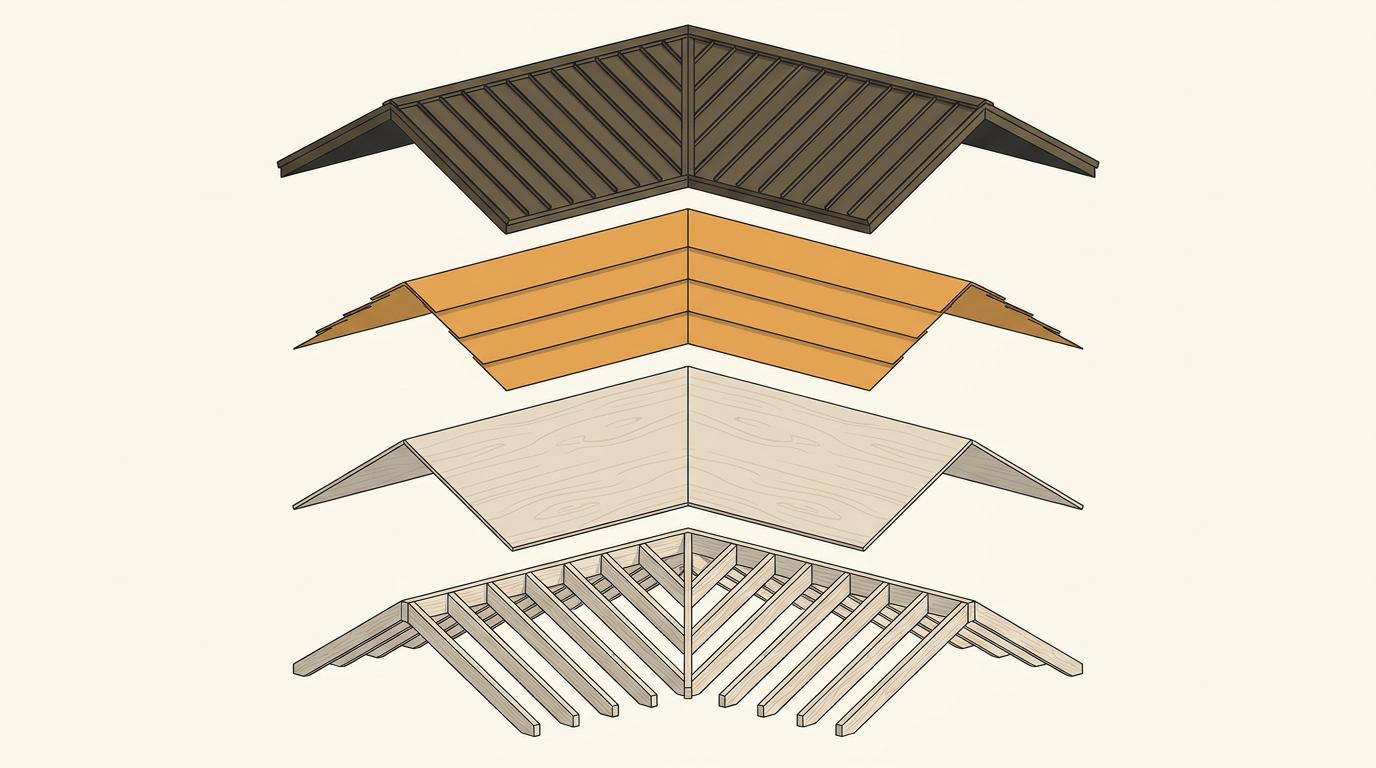
Underlayment is the layer nobody sees once the panels are down, which is exactly why it gets value-engineered on a bid and exactly why that is a mistake in Florida. It is the layer that has to keep working if the primary roof covering is ever compromised, whether that is a lifted panel edge, a failed sealant joint, or wind-driven rain finding a seam it should not.
Be precise about what the code actually requires, because this gets overstated constantly. The secondary water barrier is not triggered by a wind speed and it is not an HVHZ-only rule. Under FBC Existing Building 706.7.2, when a roof covering is removed and replaced over a sawn lumber, wood plank or wood structural panel deck, a secondary water barrier goes in, statewide, per Section 1507.1.1 or 1518.2 or R905.1.1. Slopes under 2:12 with a continuous roof system are deemed to comply, and so are clay and concrete tile systems installed to the code. The 140 mph figure people attach to this belongs to the wind-borne debris region and the roof-to-wall connection retrofit, not to the barrier.
There are three compliant methods under FBC 1507.1.1: a full deck of ASTM D1970 self-adhering polymer modified bitumen, taped deck seams under an approved underlayment, or two layers of ASTM D226 Type II or equivalent applied shingle fashion. The first is what a self-adhered high-temperature membrane gives you in one pass, which is a large part of why it became the Florida default.
What changes under a standing seam or 5V crimp panel, compared with shingles, is what sits on top of that membrane for the next few decades: metal, in direct Florida sun, for months at a stretch.
Why Florida heat changes the underlayment decision
A metal panel in direct sun runs hotter at its surface than the shingles it replaces, and the deck underneath it spends a Florida summer holding onto more of that heat for longer than a shaded, ventilated assembly would. That matters because a self-adhered membrane is only as good as its temperature rating. Every self-adhered underlayment on the market carries a rated ceiling for the asphalt-based adhesive that bonds it to the deck. Push a membrane past what it is rated for, for long enough, and that adhesive can soften. A membrane that has softened can slip out of position, lose adhesion at a lap, or bleed at a fastener penetration - and it tends to do that quietly, years before anyone is on the roof to notice, which is exactly when you do not want to discover it.
This is the honest reason underlayment is not the line item to cut corners on under metal. The panel itself is doing its job as the primary water shedding surface. The membrane underneath it is the layer that has to survive Florida roof-deck heat for the life of the roof and still function as a backup on the day it is actually needed. A membrane that is marginal on temperature rating might perform fine in a mild climate for years and still be the wrong call on a Florida deck, because the two environments are not asking the same thing of it.
Slip resistance matters before the panels ever go down
There is a second, more immediate reason temperature rating and surface texture both matter in Florida: a crew is walking the deck on the membrane itself before a single panel is fastened down. On a summer install, that membrane is absorbing direct sun for hours while trim gets cut, panels get staged, and fasteners get laid out. A membrane engineered with a slip-resistant walking surface is a real jobsite safety detail, not a footnote, on a deck that is both hot and pitched.
What Titanium PSU30 is rated for
We supply Titanium PSU30 as the underlayment under every panel we sell, and we would rather state exactly what it is rated for than lean on a marketing adjective:
- Self-adhered, peel-and-stick membrane - no torch, no mopped-in asphalt
- Rated to 240°F, a high-temperature threshold built for what a roof deck sees under metal in Florida sun
- Compatible with metal, tile, slate, and asphalt roofing systems
- Slip-resistant walking surface, which matters on a hot deck before the panels go down and a crew is still walking it
- Carries Florida Product Approval FL11602-R19, Non-HVHZ
That last point is worth being precise about. FL11602-R19 is a non-HVHZ approval. The underlayment and the panel each carry their own approval, and a full submittal package needs both. Whether that specific non-HVHZ approval is accepted beneath an HVHZ-approved panel assembly is a question for the panel's approval documentation and the building department reviewing the job, so confirm it before ordering for Miami-Dade or Broward. We would rather confirm the whole assembly with you before an order ships than have a plan reviewer catch a mismatch first. As with any approval number, verify the current revision at floridabuilding.org before submittal.
Deck prep before the membrane goes down
Underlayment performance starts with what it is bonded to, not the membrane itself. A high-temperature, self-adhered product is only as good as the deck it is asked to stick to, and Florida re-roofs in particular tend to uncover deck issues that a shingle tear-off would not have exposed until the membrane crew got up there. A few things worth getting right before PSU30 goes down:
- Confirm the deck matches what the panel's Florida Product Approval actually requires. Our standing seam profiles are approved over 15/32-inch minimum plywood; NS100 in 26 gauge has a separate approval that allows 7/16-inch OSB. That is not an interchangeable detail - the approval is written for a specific substrate, and swapping it changes what the assembly is actually rated for.
- Check for delamination, soft spots, and protruding fastener heads before rolling out membrane. A self-adhered membrane bonds to the deck surface it is given; a compromised deck undermines that bond regardless of how the membrane itself is rated.
- Sweep the deck clean and let it dry. Moisture and debris under a peel-and-stick membrane are the most common reason a bond fails early, and in Florida's rain patterns that is a real scheduling constraint, not a formality.
- Lap and seal penetrations, valleys, and deck joints per the membrane manufacturer's instructions, maintaining a continuous secondary water barrier rather than treating any one detail as an afterthought.
None of this is unique to Florida in principle. What is unique is how unforgiving the climate is of skipping it - heat accelerates whatever a deck problem was already going to do, and a hurricane season arrives on a schedule the roof does not get to negotiate.
Underlayment and HVHZ orders
A question we get from contractors working across county lines: does the underlayment change between a Jacksonville job and a Miami-Dade job? The membrane itself does not change - PSU30 is the same product either way, and it carries the same non-HVHZ approval wherever it is installed. What changes is the paperwork the job has to satisfy and which panel goes over it. Section D of the HVHZ Uniform Permit Application names the underlayment by type, so confirm it against the panel assembly's approval documentation and with the building department before ordering for Miami-Dade or Broward. Some of our standing seam profiles hold Miami-Dade and HVHZ approval and some do not; see our HVHZ vs non-HVHZ breakdown for the full panel-by-panel list before you spec a job inside Miami-Dade or Broward County. The underlayment is one part of a submittal package, not the part that determines whether a panel is eligible for the zone.
Getting the rest of the assembly right
Underlayment is one line on a material list that is easy to treat as a commodity. It is not one, once you account for what a Florida roof deck actually does to it over a decade of summers. The membrane costs less than the panel that goes over it and does more of the quiet, unglamorous work of keeping a building dry when something above it does not go according to plan. That is a trade worth making deliberately rather than by default.
If you are speccing a job and want the deck substrate, membrane, and panel confirmed together before you order, our Instant Metal Quote platform builds that material list against the approval each panel actually holds, or contact our sales team directly and we will walk through the assembly with you.

